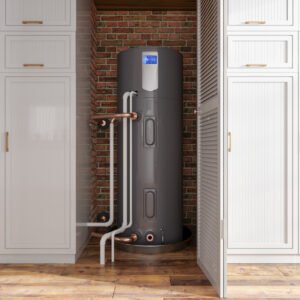
The big decision: standard electric vs. ENERGY STAR® certified heat pump water heater
Heat Pump water heaters are ~70% more efficient that standard electric water heaters and save the average households in the US $497* every year on their electric bills. A Heat Pump water heater is the only water heater that quickly pays for itself (payback) with the energy savings.
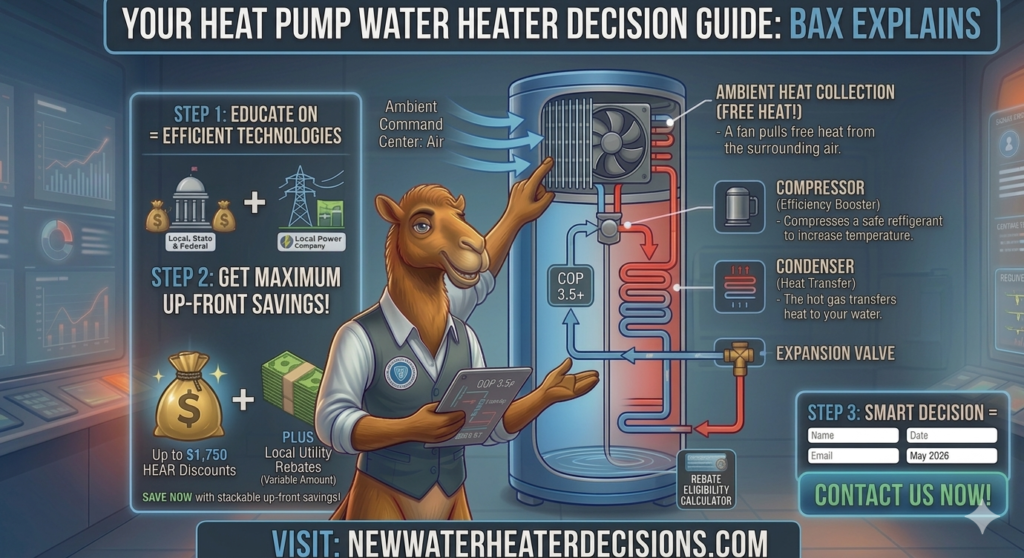
Heat Pump water heaters pull heat from the surrounding ambient air and pass it on to the water. They operate like your refrigerator, just in inverse. It is much more efficient to transfer heat than to create heat.
Heat pump water heaters get installed exactly like a standard electric water heater. The only difference is the need for a condensate drain nearby (or use a condensate pump to a sink) and a minimum of ~700 cubic feet (i.e 10′ x 10′ x 7′) around the water heater (consult the specific manufacturers’ Use & Care manual, louvered doors and air ducting options exist for smaller enclosures).
To operate properly Heat Pump water heaters cannot reside on a recirculation system that runs continuously. Install a timer or a motion sensor.
*Based on DOE test procedure and Energy Guide comparison of 50-gallon nominal capacity pre-2015 standard electric (3,609 kWh) and ACiQ 50-gallon heat pump water heater (866 kWh) using DOE EF to UEF conversion rates. Annual energy savings of 2,743 kWh/year and average US residential electricity cost of 18.12 cts/kWh. Savings may vary. Source accessed March 2026: https://www.eia.gov/electricity/monthly/epm_table_grapher.php?t=epmt_5_6_a
Energy Savings Calculator
Annual Savings: $0.00
10-Year Lifetime Savings: $0.00
Calculator Disclaimers & Methodology:
Savings Estimates: Annual savings are estimates based on U.S. Department of Energy (DOE) test procedures comparing a 50-gallon pre-2015 standard electric water heater (3,609 kWh/year) to a modern ENERGY STAR® certified Heat Pump Water Heater (866 kWh/year).
Fuel Assumptions: Gas and Propane savings calculations assume a typical 0.6 Uniform Energy Factor (UEF) efficiency for standard combustion units and current local average fuel costs.
Data Source: Energy rates are based on the most recent residential data provided by the U.S. Energy Information Administration (EIA) as of March 2026.
Variability: Actual savings will vary based on household water usage patterns, local climate conditions, installation efficiency, incoming water temperature, and specific utility rate structures (such as tiered pricing or time-of-use plans).
Questions and Answers on Heat Pump Water Heaters [HPWP]
| Myth | Fact |
| HPWHs don’t work in cold climates. | They work nationwide. While they are most efficient in warm air, modern units can extract heat from air as cold as 37°F. Most are “hybrid,” meaning they switch to standard electric backup if it gets too cold. |
| They take forever to recover hot water. | Hybrid modes match standard speeds. In “Hybrid Mode,” the unit uses the heat pump and a traditional element if you’re using water faster than the pump can keep up, ensuring you don’t run out. |
| They are too noisy to have in the house. | They sound like a modern dishwasher. Early models were loud, but current units operate at about 45–55 decibels. If installed in a garage, basement, or utility room, you’ll barely notice the hum. |
| They make the room freezing cold. | The cooling effect is minimal. A HPWH does exhaust cool, dry air, but in a typical basement or garage, the temperature drop is usually only 1 to 3 degrees F. In summer, this actually acts as “free” air conditioning. HPWH also act as dehumidifiers. For homeowners with damp basements, a heat pump water heater can assist or possibly replace a standalone dehumidifier, saving even more on the monthly power bill. |
| The upfront cost is never worth it. | They start paying for themselves from day 1. While they cost more upfront, they are 3–4x more efficient than standard tanks. With State HEAR instant discounts and local utility rebates, the purchase cost premium often disappears instantly. |
| They require constant maintenance. | It’s just one extra step. Just like your HVAC system, you just need to slide out a small air filter and rinse it off once or twice a year to keep the airflow steady. |
Which size Electric tank do I need?
Family of 1 to 2: 30 gallons
Family of 2 to 3: 40 gallons
Family of 3 to 4: 50 gallons
Family of 5 or More: 80 gallons
Source: https://www.lowes.com/n/buying-guide/water-heater-buying-guide
DIY INSTALLATION OF A HEAT PUMP WATER HEATER